NEWS

Thursday, May 26, 2011

Google unveils 'Google Wallet'

 Google is unveiling a new age for payments through its electronic wallet for Android Phones at an event held at New York. It will be launching its long time plan of mobile payments which will be known as 'Google Wallet.' Users of Android phones equipped with an NFC chip will be able to use this new service. Initially the service will be made accessible to cities like New York, San Francisco, Los Angeles, Chicago and Washington, D.C.

This new method of payment will allow consumers to make store purchases and redeem coupons by waving smartphones at checkout counters. The service is expected to tap near-field communications technology and would allow users to pay for retail purchases by holding the devices up to a specialized reader at checkout counters.


Near-field communications allows devices like mobile phones, to swap and exchange information wirelessly when they are near each other, about 4 inches. Consumer can use the NFC technology to pay for items by using their smartphones to send payments directly from their bank accounts to a store terminal.


Speculations were high that Google was partnering with MasterCard and Citigroup to allow the financial giants' customers to use their debit and credit cards to pay for purchase from their Android smartphones. It is to be noted that Google also paid for the installation of thousands of NFC short-range, wireless point-of-sale systems from VeriFone at stores in New York and San Francisco.


It is anticipated that around 40 million to 50 million NFC-equipped phones will be sold in 2011, according to a research firm Forrester. However initially only two phones will be available with NFC chips installed in United States and they are Google Nexus S and the Nokia C7 or Astound. Soon many more will join the league once the service will kick start.


Apart from Google many other companies are also keen to make utilization of the demand for mobile payments business. Microsoft is planning to include NFC technology in a future phone of Windows Phone 7. T-Mobile, AT&T, and Verizon have already formed a joint-venture payment system called Isis which is predicted to hit the market soon. However Apple's upcoming iPhone 4S and iPhone 5 are believed to be without NFC.


The only big challenge that lies ahead of these giants is to instill the confidence among its consumers about the security as mobile payments still scares people of losing their money and data.

Thursday, April 21, 2011

A primer on the New Pension Scheme (NPS)

You can call it New Pension Scheme, National Pension System, New Pension System or NPS, anything you like. They’re all the same; I’ve seen different articles call them different names, so that might get a bit confusing, but you’ll soon get used to it.


Next up, some of the things this post will address, are:

What is the New Pension Scheme?


What are Tier I and Tier II accounts in the NPS?


What are the three categories in the NPS?


Fees and Expenses related to the NPS?


What is the minimum amount needed to invest in the NPS?


What are the tax implications of NPS?


How can I open a NPS account?


Why hasn’t this become popular?


What is the New Pension Scheme?

The NPS was introduced by the government last year to give people a way to get a pension during their old age. Employees of the government sector already get a pension, so this scheme was introduced as a social security measure that enables people from the unorganized sector to draw a pension as well.

The working mechanism is quite simple – you contribute a certain sum every month during your working years, which is then invested according to your preference. You can then withdraw the money when you retire, which is currently set at 60 years old.

When I say you invest according to your preference, I mean that there are a couple of different options that you need to select from. These options pertain to your preference on withdrawal, and asset allocation.

What are Tier I and Tier II accounts in the NPS?

The NPS is meant to be a pension scheme, so it is geared towards giving you a steady stream of income on your retirement.

That means that NPS makes it difficult to withdraw your money during your working years or till the age of 60 in this case.

Tier I and Tier II are two options under the scheme where you can invest your money, the primary difference between them is how they differ in allowing you to withdraw your money before retirement.

NPS Tier I

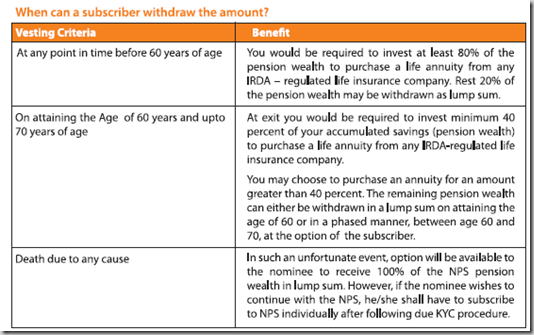
There is severe restriction on withdrawing your money before the age of 60, because it is necessary to invest 80% of your money in an annuity with Insurance Regulatory Development Authority (IRDA) if you withdraw before 60. You can keep the remaining 20% with you.

When you attain the age of 60, you have to invest at least 40% in an annuity with IRDA; the remaining can be withdrawn in lump-sum or in a phased manner.

Here are the details of how your money can be withdrawn in a NPS Tier I account.


Death is another way of getting the money, but that might come in the way of other plans you have.


NPS Tier II Account

The first thing about the NPS Tier II account is that you need to have a Tier I account in order to open a Tier II account.

The Tier II account makes it easy for you to withdraw your money before retirement because there is no limit on the withdrawals you can make from the Tier II account.

You need to maintain a minimum balance of Rs. 2,000, and you can transfer money from the Tier II account to Tier I account, but not the other way around.

There is a Rs. 350 CRA (Credit Record Keeping Agency) charge which is not present in the Tier II account, but the rest of the fees remain the same.

Asset Allocation and Categories in the NPS

There is an Active Choice option, and an Auto Choice option. If you select Auto Choice then your money is invested in a certain percentage in the various classes based on your age.

Here are the three investment classes:

Class              Risk                      Profile Description

G            Ultra Safe              Will only invest in Central and State government bonds.

C            Safe                      Fixed income securities of entities other than the government

E             Medium                Investment in equity related products like index funds that replicate the
                                            Sensex. However, equity investment will be restricted to 50% of the portfolio.

In the Active Choice you can select how much of your money will be invested in the different classes with a cap of 50% in Class E.

Now, there are pension funds that will manage your money, and in either of these options you have to select the fund manager who will manage your fund. So even if you select the Auto Choice, you still have to tell them which fund manager you want to manage your money.


Fees and Costs related to the NPS

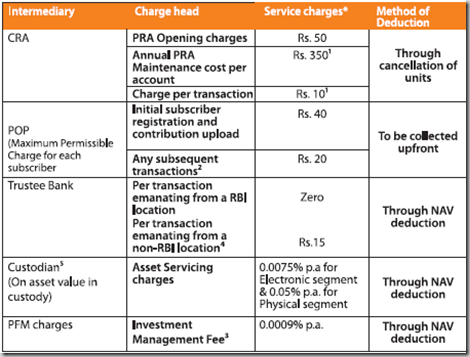
I talk about expenses a lot here, and the expenses on the NPS are really low. The annual fund management charge is 0.0009%, which is probably the lowest in the world.

There are some other expenses associated with the NPS, but as you will see all of them are quite low as well. Here is a list of the other expenses.


What is the minimum amount needed to invest in the NPS?


For a Tier I NPS account you need to contribute a minimum of Rs. 6,000 per year, and make at least 4 contributions in a year. The minimum amount per contribution can be Rs. 500.

Minimum amount for opening Tier II account is Rs. 1,000, minimum balance at the end of a year is Rs. 2,000, and you need to make at least 4 contributions in a year.

What are the tax implications of NPS?

The revised Direct Tax Code proposes to make the NPS tax exempt at the time of withdrawal. Initially NPS was going to be taxed at the time of withdrawal, and that had put it at a disadvantage to other products like ULIPs and Mutual Funds. But the revised code proposes it to be exempt from tax, and that really adds to its lure.

How can I open a NPS account?

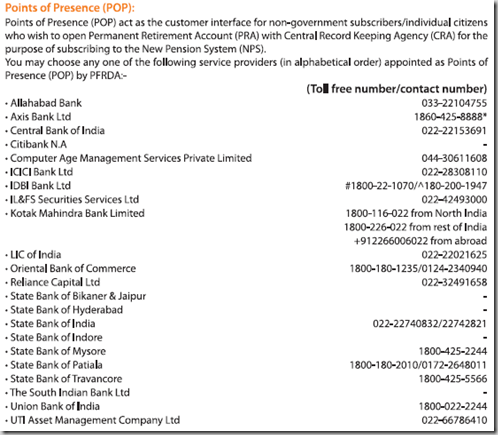
You can open a NPS account by going to the bank branches of the banks that are authorized to sell this.


Conclusion


This is quite a good option for people who wish to invest for their retirement, and the government has done good to come up with such an option. It is still early days for the scheme so there are going to be some teething troubles, and I am sure you have come across several articles that write the NPS off completely, or suggest major changes.

While it has not gained in popularity the way you would’ve expected with the low cost structure, a primary reason of that is there is no real incentive for anyone to push this to consumers, so it has not gained any real traction.

reference: onemint

Which is the best gold ETF in India?

Let me begin this post by saying that this is just my way of deciding which is the best gold ETF in India, and you are free to poke holes in this methodology, or even reject it outright, but if I were to invest in a gold ETF – this is the way I would go about it.


First off – I’d compare the expense ratios of all existing Indian gold ETFs, and see which are the ones with the lower expenses. I have already done that research earlier on this blog, and know that right now the Gold BeeS ETF from Benchmark Funds has the lowest expense ratio of 1%. Quantum Funds comes second with 1.25%. All the other funds charge higher expenses. The lower the expenses – the better it is because it leaves more on the table for investors.

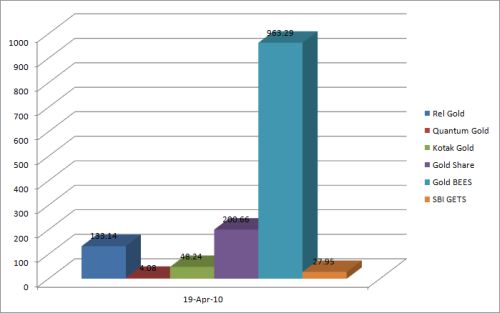
Expenses alone are not enough for me because I want my investment to be liquid, and need the fund to have good volumes too. I went to the NSE website and gathered the volume data for all gold ETFs for the last month or so. I am presenting you yesterday’s volume data of all gold ETFs here. I am presenting just one day’s worth of data because that is pretty much representative of the overall volumes and is easier to read.


Gold ETF Volumes in India

As you can see from the image – Gold BeeS, which has the lowest expenses also has the highest volume, and by a large margin too.


That does it for me – and if I had to invest in a Gold ETF – it would be this.

Keep in mind though that this is just my opinion and not expert advice tailored to your investing situation.

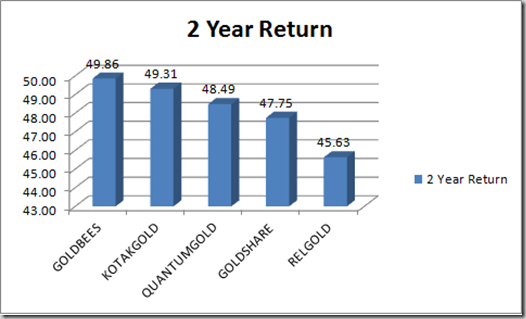
I read that HDFC is coming out with a new gold ETF, so I thought I’d check out how the existing ones are doing, and see what is the difference in returns between the gold ETFs that are already present in the market.


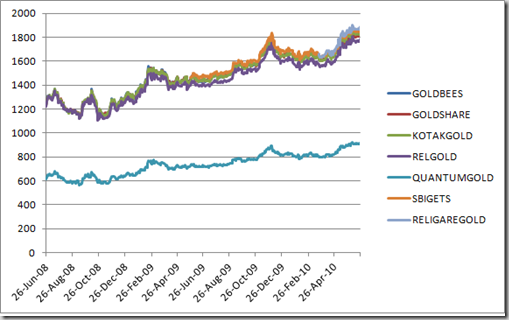
I went to the NSE website, and looked up the closing prices for all 7 existing gold ETFs for the past couple of years.

Here is how they have moved over the past two years.